The book

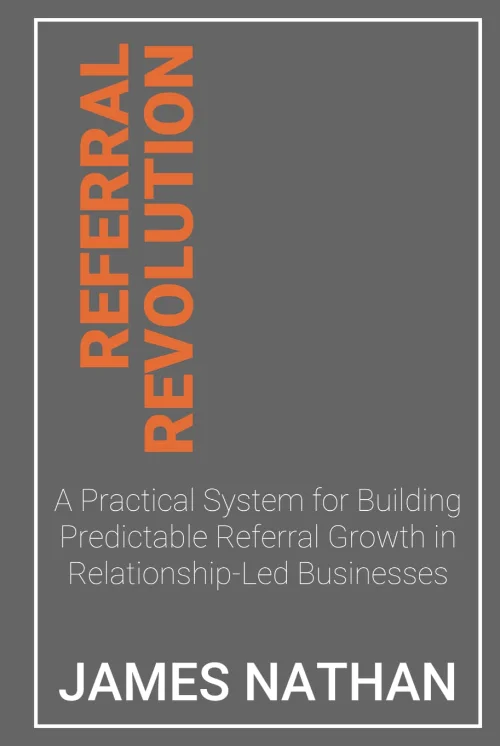
Referral Revolution®

A Practical System for Building Predictable Referral Growth in Relationship-Led Businesses

Referrals are your best source of new work. So why do they still feel unpredictable? Referral Revolution® shows relationship-led businesses how to stop hoping for referrals, and start designing for them.

Buy on AmazonRead a sample

Hardback, paperback and Kindle

Referral Revolution® by James Nathan, book cover

Why this book

We all love getting referrals, and for most firms they’re the best way to win new work. Yet very few businesses have the systems and processes to encourage them and grow them. Referral Revolution® is built to do exactly that.

Stop hoping, start designing

Most firms leave referrals to chance. The book shows you how to design for them, so they arrive more often and more predictably.

Not networking harder

This is not a book about networking harder or asking more often. It’s about building a clear, professional system.

Make referring you easy

A system that makes referring you feel safe, natural and obvious, for clients, colleagues and contacts alike.

Built on trust

If your business runs on trust, the book shows you how to turn that trust into consistent growth.

You will learn

The whole system rests on the virtuous circle of referrals: the 3Cs of Clients, Colleagues and Community.

01

Clients

Engage and educate your clients to refer the right kind of prospects more often, through the client journey, outstanding service, Super Soft Selling™ and an effective referral process.

02

Colleagues

Harness the hidden sales force already inside your business. Capture the potential of cross-selling to existing clients, and improve internal networking and cross-department referrals.

03

Community

Build trusting strategic relationships while you expand your network and spread the right referable message, with meaningful, authoritative content that sells.

What changes afterwards

  • ✓A clear, repeatable system for referrals
  • ✓Clients who refer the right kind of prospects, more often
  • ✓Colleagues cross-referring across the firm
  • ✓A network that knows exactly who to send your way

Samples from the book

Open a chapter to read an extract.

Introduction

The hope-based referral problem

Most businesses rely on hope-based referrals. Hope-based referrals look like this:

  • Deliver good work
  • Be professional
  • Network regularly
  • Stay visible
  • Hope people remember you
  • Hope they feel confident enough to refer
  • Hope they do it at the right time
  • Hope it keeps happening

Hope is not a strategy. It is optimism without control.

And if referrals are your primary source of new business, as they are for most relationship-led businesses, basing your growth on hope is risky.

Chapter 2 · Why You

The silent referral filter

Every potential referrer runs an internal checklist, whether they realise it or not. It usually sounds something like this:

  • Do I really understand what they do?
  • Do I know who they are best suited for?
  • Would this introduction help or harm my relationship?
  • Will they make me look good?
  • Will they handle this professionally?
  • Will they thank me, or forget I helped?

If any of those answers are uncertain, the referral doesn’t happen. Not out of malice. Out of caution.

Your talkable difference

For a referral to happen, there must be something talkable. Not your full service offering. Not your entire value proposition. One clear reason someone thinks of you.

You can do many things. You should be known for one.

Chapter 4 · The 5 Truths of Referral

Referral decisions are emotional, not logical

We like to believe referrals are rational decisions. Those things matter, but they are not what triggers referral behaviour. Referrals are emotional decisions wrapped in logic after the fact.

This is why referrals often come from moments, not meetings. A client hears a colleague struggling. A contact sees a mistake being made. A partner recognises a familiar problem. And in that moment, they think of you. Not because of your credentials. Because of how you made them feel.

Referral involves risk

A referral doesn’t remove risk. It redistributes it. The referrer takes on part of the risk. Their reputation is now involved.

This is why people hesitate. They aren’t withholding referrals. They’re protecting relationships.

Chapter 6 · Asking for Referrals

Never put people on the spot

One of the fastest ways to kill referral goodwill is to ambush someone. Avoid asking in public, asking without warning, or asking for names immediately. Instead, use advance notice. For example:

“Do you remember when we first met? I mentioned how the majority of our business comes by personal referral? Next time we speak, I’d love to ask you if there was anyone you might know who would benefit from working with us too.”

Control reduces risk. Reduced risk increases action.

Be specific, always

The biggest mistake people make when asking is being vague. Instead of “If you hear of anyone who needs us…”, be precise about the type of client, the problem they’re facing and the situation they’re in.

Referrers don’t look for referrals. They notice them.

Chapter by chapter

Eight chapters, each ending with a case study, and a 90-day action plan to finish.

Introduction

Being Totally Referable

  • The hope-based referral problem
  • Passive referrals vs proactive referral systems
  • From hunting to being found
  • The referral tragedy

Chapter 1

Why, Who, What and Where

  • Why doing good work is not enough
  • Who actually refers you: clients, colleagues and community
  • What it means to be referable
  • Where referrals are really generated
  • Case study: a management consultancy

Chapter 2

Why You

  • The silent referral filter
  • Your talkable difference
  • Differentiation is not being louder
  • Positioning yourself as a referral-based business
  • Case study: a commercial law firm

Chapter 3

The Ideal Client

  • The cost of accepting the wrong clients
  • The three layers of the ideal client
  • Saying no is a referral strategy
  • Case study: an accountancy group

Chapter 4

The 5 Truths of Referral

  • Referral decisions are emotional, not logical
  • Referral involves risk
  • Consistency builds trust
  • You need a system, not an event
  • Case study: an independent consultancy

Chapter 5

Being Found

  • Referability is not visibility
  • The hub-and-spoke principle
  • Online and offline must converge
  • The quiet power of repetition
  • Case study: a tax and advisory practice

Chapter 6

Asking for Referrals

  • Why asking often fails
  • Getting the timing right
  • Never put people on the spot
  • Be specific, always
  • Case study: a corporate and employment law firm

Chapter 7

Where to Focus Your Efforts

  • The two places referrals actually come from
  • Your existing clients
  • Strategic partners
  • Stop spreading yourself thin
  • Case study: a recruitment firm

Chapter 8

Action

  • Decide to be referral-led
  • Your four anchors and the client journey
  • Make referrals easy, and build in gratitude
  • Measure what matters, review quarterly
  • Case study: a growth consultancy

Conclusion

Becoming Totally Referable

  • Why this matters more than ever
  • The competitive advantage most businesses ignore
  • Your Monday morning

Appendix

The Referral Revolution® Action Plan

  • The 90-day referral system build
  • Days 1–30: clarity and focus
  • Days 31–60: system and structure
  • Days 61–90: action and reinforcement

What people say about Referral Revolution®

“Brilliantly effective, a no brainer and easy to implement.”

Rohit Talwar, Futurist, Strategic Advisor, Author and Keynote Speaker

“I’ve been struggling to ask a great long term client about referrals. Following your session, I understand why – and what to do about it.”

Helen Lamb, Strategic HR Consultancy and Business Partnering

“Just heard James talking about his referral revolution process. Very impressed. The audience focused on his every word as he was evidently speaking with authority… I learned plenty. And less experienced audience members learned even more.”

Mark Lee, Speaker, Facilitator and Mentor for Accountants

“He was a keynote for me at the Bookkeepers Conference and shared his ‘Referral Revolution’ system. The feedback from the delegates was fantastic, but more relevant was those that I mentor who took ‘action’ on the expertise shared and actually experienced an improvement with the referrals they receive.”

Mike Foster, Commercial Director, The Bookkeepers Alliance

Read more client feedback

Hardback, paperback or Kindle

Choose the format that suits you. All three are available from Amazon.

Referral Revolution® by James Nathan, hardback

Hardback

A lasting edition for your shelf, or a gift for a partner or colleague.

Buy on Amazon

Referral Revolution® by James Nathan, paperback

Paperback

Delivered to your door. Ideal for reading, marking up and keeping on the desk.

Buy on Amazon

Referral Revolution® by James Nathan, kindle ebook

Kindle eBook

An instant download from the Kindle Store. Be reading in under a minute.

Buy on Amazon

James Nathan, business development trainer and author

About the author

James Nathan

James Nathan helps professional firms win and keep clients. Over the last 25 years he has advised professional firms, consultancies and specialist businesses that rely on reputation rather than advertising, through training, coaching and keynote speaking.

He teaches a healthy mix of confidence, skill and mindset, through Super Soft Selling™, business development, Referral Revolution® and client relationship excellence.

“The so-called rainmakers were trained, coached and mentored, and with the right help anyone can join them.”

More about James

Want this taught to your team?

The book sets out the system. The Referral Revolution® workshop and keynote put it to work in your firm, written around your clients, your market and your people.

Get in touch or book a 20‑minute callThe workshop and keynote